Oooh, this post is so overdue it's not funny... Ah, well, better late than never...
About the 10th Hong Kong Asian Open
This is an annual kendo tournament, organized by the currently 30 year old Hong Kong Kendo Association, with 3 main events, being:
Women's 3-person team - 27 teams competing
Men's 3-person team (3rd dan and below only) - 44 teams competing
Men's 5-person team - 51 teams competing
My dojo, the Japan Club of Kuala Lumpur, entered 1 team for the women's event, and 2 teams for each of the men's events.
The competition was held from 12th to 14th March in Tin Shui Wai Sports Centre, conveniently located 5 minutes walk away from Harbour Plaza Resort City, which housed, by my reckoning, about 300+ kendokas over that weekend.
While the purpose of this blog entry is primarily to cover my own performance to look back on and think about, it's worth noting that Malaysia's women's team performed exceedingly well, having won the women's event last year and this year coming 2nd only to these 3 tiny 18-year-old girls from Fukuoka, which just goes to show how seriously kendo is taken in Japan...
Quick intro to team shiai
Team shiai takes place between 2 teams of up to 5 members each. In order of who fights from first to last, their titles are:
- Senpo
- Jiho
- Chuken
- Fukusho
- Taishou
In the case of 3-man teams, the titles jiho and fukusho are dropped. The shiai-jou (court) is a square, about 10m a side, and each team member will fight once against his opposite in the opposing team, i.e. Senpo vs senpo, jiho vs jiho, etc.
There are 3 shinpan (judges) watching the combatants, and to take ippon, at least 2 out of 3 of them must raise their flags in your favour. If one raises a flag, but one or both of the other two wave their flags below their waists, some element of the cut must have been missing for the strike not to count. It is no exaggeration that judging a shiai is not a science, it's an art. In awarding ippon, the shinpan will consider a great many factors, for example:
- Was there sufficient seme (attacking spirit)?
- Does the kendoka display proper form and posture?
- Was the strike solid?
- Was there sufficient zanshin?
Between these questions and the blistering speed of competitive kendo, trusting a machine to award points as in fencing is impossible.
For this tournament, all rounds were 3 minutes long, with the winner decided by the best of 3 points, i.e. first to 2 points wins, with a point being ippon, as discussed in the previous post.
My performance - Day One
My first 2 fights were as taishou (team leader) of Malaysia's 3-man B team. Quite an honour, given that this is my first time in an international tourney. To be honest, I don't feel qualified to pass comment on the performance of my teammates, so I'll keep to discussing the experience from my own point of view.
My first fight was against a chap from Macao, slightly shorter than me, but stouter. Despite my best efforts, I couldn't quite relax. I couldn't perceive it from where I was, but I'm told by my seniors and teammates that I tend to tense up a lot when I'm nervous, slowing down and expending tremendous amounts of strength in huge, crushing blows which, while they look impressive, have absolutely no way of scoring ippon, even if they contacted a target.
I lost one point early on, getting struck on the right kote (the gauntlet, on the wrist), if I recall correctly. I would find out later that because of my height and build (6', broad shoulders), that would tend to be the target of choice for most of my opponents. Unfortunately, my ability to counter such attacks was, at the time, sorely wanting, as I found out the next day...
In any case, having lost the first point, I was galvanized to do whatever I could to equalize and, in a series of clashes quite akin to jousting, with charges and near-simultaneous attacks, I managed to come out on top and took my first ippon in an international tourney. Yay, me! I was so excited the rest of the fight was absolutely frenzied, but alas, in kendo, brute strength and sheer aggression aren't quite enough; my opponent patiently waited for the inevitable opening and bopped me again.
This first fight was hell of an experience, to say the least, and I can safely say nothing will quite compare to the sheer rush I experienced that day. My vision narrowed, my hearing dulled, my heart and lungs went into overdrive... Months of training crumbled and gave way to instinct. My teammates' shouts for me to relax sounded like distant whispers then, and I spent every ounce of strength in that fight. Quite literally, too. After we'd bowed to our opponents my fingers were still numb and my teammates had to help me remove my helmet (as taishou, I keep my helmet on during the last bow). The memories of this fight won't leave me in a hurry.
The upshot to wearing myself out so thoroughly in that first fight was I was significantly more relaxed for my next fight, and I was in fact able to my some of my training to good use. My second and last fight of the day was against a chap from one of Hong Kong's many teams, shorter and lighter than me, and noting this, I took care to defend my right kote. It was during this fight that I learnt most about what is possibly my biggest weakness in shiai, which I have endeavoured to correct ever since - no zanshin.
This being only my 2nd fight ever in such a big tourney, I was still nervous, and struck with brutality far better suited to baseball bats and sledgehammers than a shinai. Still, I had the presence of mind to create an opening and land a vicious blow to my opponent's head, but from the corner of my eye, I saw flags being waved; no ippon. Naturally, this was quite frustrating, but I continued, wondering what was missing. I surmised, rather stupidly, in retrospect, that I wasn't hitting hard enough*. So I hit harder. No ippon. So I hit even harder. Still no ippon. 3 monstrously hard blows to the guy's head and still nothing?! What was I not doing? I managed to land one more crushing blow to his head. I was too close for it to score, but it still raised some eyebrows because of the sheer brutality of it. In the end, I faltered, and lost a point in the final seconds.
I would find out later that night that this fight left such great big cracks in my shinai that another fight would most certainly break it, at which point I felt really, really guilty at what the poor devil must have endured. I'm told my strikes hurt in basic training when I'm concentrating on form and precision rather than force. One can only imagine what blows that would ruin my shinai felt like...
After the 3-person tournaments were over and prizes where given out (M'sia's women's team brought back lotsa shiny medals and trophies, congrats if you're reading), came goudo keiko. Basically, everyone gets to train together for a bit. There were 8th dan senseis present and, rare as they are, huge queues formed for a chance to train with them.
I waited about 40 minutes to train with Fukumoto sensei, an imposing hulk of a kendoka, standing as tall as me and easily broader. 8th dan is the highest rank attainable in kendo, and I quickly learnt why. In this sort of informal training, the student faces off against the sensei, and in the first few seconds, it starts off like a shiai, during which the sensei assesses the student's level of skill. He'll cast an expert eye over you, checking form, spirit, technique and then decide how best to spend your brief encounter with him. If he's particularly impressed, he will invite you to fight him for ippon.
I can tell you I tried my level best, spending the time waiting for him by watching him and thinking how I will get past his guard. By the time my turn came, I had nothing on him. I stood before him and found no gaps to exploit. Fine, I thought, that's simply characteristic of good kamae (stance), so I will poke around, probe a bit and attempt to make a gap. No such luck. There's nothing quite as humbling as fighting someone who knows what you're going to do before you do it. It was like being hopelessly outclassed in chess, I simply couldn't see as far into the future as he could. I go for his head, his shinai blurs, my shinai bounces harmlessly away, a sharp blow smacks into my do (body, about gut-level) and he's standing behind me. I feint for the head and go for his do and my shinai bounces off his, he stands, unmoved, shouting inches from my face, "What are you doing?! Go STRAIGHT!" I might as well have been a mosquito trying to bite a rhinoceros...
As such, I was deemed worthy for a short stretch of kakarigeiko, in which he would deliberately leave gaps for me to attack, and I was to strike the targets as quickly as possible. All the while enduring his deluge of verbal abuse and the occasional whack over the head if I didn't move fast enough. This is normal in kendo. Juliette, if you're reading this, don't worry, they're generally gentler with girls. Guys my size, however, get no mercy. After about a minute or so of this, we made our bows and I staggered off and called it a day...
Coming next, Day Two (mercifully short) and my reflections on what transpired that weekend.
* Those who have trained with me will know that hitting hard enough has never been an issue for me. Good form, however, is another matter entirely...
Wednesday, April 14, 2010

Monday, March 22, 2010
Big Pond...
Note: This post was first drafted about 2 weeks ago, and since the events of the Hong Kong Open, my understanding of kendo has since been subtly altered. I'm putting this up on the blog anyway to track the progression of my understanding of kendo.
This blog has, of late, been woefully neglected. Apologies to those who've actually been waiting for a new post. There are any number of reasons for this, not least of them being training for a big kendo tournament in Hong Kong later this week. It's the first time I'll be participating in any sort of serious international tournament (the friendly tourney with Singapore last year doesn't count) so I'm feeling a bit like a wee minnow chucked in a big, big pond. So, I figured now's a good time to take stock of where it feels like I presently stand in kendo for future reference. Something to look back on and laugh over far in the future when the glorious day comes that I (successfully) bear two swords in tournament...
Fighting in the tournament arena (shiaijou, 試合場) is an extremely different experience from the brief, fleeting duels in a crowded dojo. Granted, the objective (i.e. take ippon) is the same, but the criterion are far, far more stringent. I know for a fact, I've taken ippon many times in the dojo, but every one of them would have been worthless in a tournament. So what does ippon in a tournament take?
Well, as I understand it, a valid strike in kendo, known as yuuko datotsu (有効打突), comprises three main elements:
1. Seme (攻め) - This literally translates as attack, but in the context of kendo, 'approach' is possibly a better word. Broadly speaking, this describes how one moves from outside of striking distance to within striking distance. There are any number of ways to achieve this, e.g. pushing into the centre line, slapping the opponent's sword aside, slipping under the opponent's sword, charging and knocking the opponent off balance, to name a few. Seme is also a spiritual assault, breaking your opponent's spirit with such things as kiai, the resoluteness of your stance, and the constant application of pressure.
2. Ki, ken, tai ichi (気剣体一) - This translates roughly as striking with your spirit, your sword and your body as one. Practically, by spirit we mean shouting out the name of your target (i.e. men (面) for head, kote (小手) for glove, and so on*.). The sword should strike the named target sharply with the top quarter or so of the "blade", being the side of the shinai on the opposite end of the string that holds it together. And at the same time as the shout and the strike, the right foot should stamp solidly on the floor. The foot-stamping might sound a bit odd, but when you think about it, to give a good, loud stomp, one needs to have a reasonably solid posture, and the whole body must be carefully coordinated with the strike of the shinai. If the timing of any of these elements is off, the strike simply does not count.
3. Zanshin (残心) - This could be translated literally as "remaining heart/mind", and truth be told, I consider this to be the hard bit. Zanshin, in the context of kendo, probably translates better as 'vigilance'. It begins immediately after the killing blow makes contact, from which point one's heart/mind remains firmly fixed on your opponent/victim, watchful for any further resistance or attempt to counterattack. So, even after you strike a blow where you think you've scored, you remain ready and alert for a few seconds, even if you know you've scored. On landing the cut, you most certainly do NOT make any celebratory gestures, no fistpumps, no jumping up and down, no hoots or hollers, you just level your blade against your opponent, quick as you can and be ready to strike again if the need arises. Innumerable points in kendo tournaments have been cancelled, regardless of how perfectly the cut was executed, simply because of a lack of zanshin.
Yesterday, I learnt that zanshin is where I fall short. The execution of zanshin, as I found out, demands that there isn't a shadow of doubt on the part of the kendoka. I now know that, though I am capable of landing a clean cut on my opponents, from the perspective of the judges, I'm not following through enough, i.e. not enough zanshin. I find it's not an easy thing to show zanshin, at least not to the exacting standards of kendo, not while the rush of executing a good cut is addling my mind, and especially when, from the corner of my eye, I see one judges hand go up, then another judge cancel the point.
Well, now I'm aware of the problem, there's only one thing for it: Fight MORE... There will definitely be a blog post reflecting on what happens in Hong Kong this weekend... Before then, I suppose it can't hurt to do a little studying on what passes for zanshin in Japan:
Holy hell, that speed...
* The actual name of your target doesn't count, i.e. You can't whack me over the head and shout at the top of your lungs: "CHEEEEEENG!"
This blog has, of late, been woefully neglected. Apologies to those who've actually been waiting for a new post. There are any number of reasons for this, not least of them being training for a big kendo tournament in Hong Kong later this week. It's the first time I'll be participating in any sort of serious international tournament (the friendly tourney with Singapore last year doesn't count) so I'm feeling a bit like a wee minnow chucked in a big, big pond. So, I figured now's a good time to take stock of where it feels like I presently stand in kendo for future reference. Something to look back on and laugh over far in the future when the glorious day comes that I (successfully) bear two swords in tournament...
Fighting in the tournament arena (shiaijou, 試合場) is an extremely different experience from the brief, fleeting duels in a crowded dojo. Granted, the objective (i.e. take ippon) is the same, but the criterion are far, far more stringent. I know for a fact, I've taken ippon many times in the dojo, but every one of them would have been worthless in a tournament. So what does ippon in a tournament take?
Well, as I understand it, a valid strike in kendo, known as yuuko datotsu (有効打突), comprises three main elements:
1. Seme (攻め) - This literally translates as attack, but in the context of kendo, 'approach' is possibly a better word. Broadly speaking, this describes how one moves from outside of striking distance to within striking distance. There are any number of ways to achieve this, e.g. pushing into the centre line, slapping the opponent's sword aside, slipping under the opponent's sword, charging and knocking the opponent off balance, to name a few. Seme is also a spiritual assault, breaking your opponent's spirit with such things as kiai, the resoluteness of your stance, and the constant application of pressure.
2. Ki, ken, tai ichi (気剣体一) - This translates roughly as striking with your spirit, your sword and your body as one. Practically, by spirit we mean shouting out the name of your target (i.e. men (面) for head, kote (小手) for glove, and so on*.). The sword should strike the named target sharply with the top quarter or so of the "blade", being the side of the shinai on the opposite end of the string that holds it together. And at the same time as the shout and the strike, the right foot should stamp solidly on the floor. The foot-stamping might sound a bit odd, but when you think about it, to give a good, loud stomp, one needs to have a reasonably solid posture, and the whole body must be carefully coordinated with the strike of the shinai. If the timing of any of these elements is off, the strike simply does not count.
3. Zanshin (残心) - This could be translated literally as "remaining heart/mind", and truth be told, I consider this to be the hard bit. Zanshin, in the context of kendo, probably translates better as 'vigilance'. It begins immediately after the killing blow makes contact, from which point one's heart/mind remains firmly fixed on your opponent/victim, watchful for any further resistance or attempt to counterattack. So, even after you strike a blow where you think you've scored, you remain ready and alert for a few seconds, even if you know you've scored. On landing the cut, you most certainly do NOT make any celebratory gestures, no fistpumps, no jumping up and down, no hoots or hollers, you just level your blade against your opponent, quick as you can and be ready to strike again if the need arises. Innumerable points in kendo tournaments have been cancelled, regardless of how perfectly the cut was executed, simply because of a lack of zanshin.
Yesterday, I learnt that zanshin is where I fall short. The execution of zanshin, as I found out, demands that there isn't a shadow of doubt on the part of the kendoka. I now know that, though I am capable of landing a clean cut on my opponents, from the perspective of the judges, I'm not following through enough, i.e. not enough zanshin. I find it's not an easy thing to show zanshin, at least not to the exacting standards of kendo, not while the rush of executing a good cut is addling my mind, and especially when, from the corner of my eye, I see one judges hand go up, then another judge cancel the point.
Well, now I'm aware of the problem, there's only one thing for it: Fight MORE... There will definitely be a blog post reflecting on what happens in Hong Kong this weekend... Before then, I suppose it can't hurt to do a little studying on what passes for zanshin in Japan:
Holy hell, that speed...
* The actual name of your target doesn't count, i.e. You can't whack me over the head and shout at the top of your lungs: "CHEEEEEENG!"
Friday, March 19, 2010
I aten't dead
No, really. I know I've been tres slow updating this blog of late, but I've some great big posts in the pipeline, mostly kendo-related, seeing as I just got back from a tournament in HK (in which I was thoroughly murdered. More on that later.) But yah, do bear with me a little longer, I'll see what I can throw together...
Friday, February 19, 2010
Blacklining ftw!
Alrighty then, I'm making a good start on that Space Marine army. Thanks to the large-ish contingent of Blood Angel Terminators that came with Space Hulk, the rest of the army will be painted in Blood Angel colours to match, though played as standard Codex marines (at least until Codex: Blood Angels turns up). Apart from the Space Hulk marines, I have at my disposal:
1 Captain
2 full Tactical Squads*
1 full Devastator Squad*
1 full Assault Squad
2 Rhinos
1 Land Raider Crusader
Fans of 40k may notice from the above that if it ain't plastic, I'm not interested. Of the above, the LR Crusader and about 12 bolter-armed marines were hand-me-downs from nephews too young to even assemble a mini**. Hurray for Xmas and misinformed aunts, eh? So, easily a good 1000pts there, with room for tweaking, though I'd like to have a couple of Landspeeders. Up til today, I've been slipping in a little painting time mostly getting through the tedious bit: Coating the little devils with Blood Red. It takes about 5 coats of decently thinned Blood Red to get a nice finish to work with. And up til today, I've been using a hideously tedious method to shade. See previous posts on painting Space Hulk for details. Thing about that method is, owing to my current ineptness, it's a bit hit and miss. Sometimes I can get the wash to behave and slip happily where I want it to with minimal fuss, the rest of the time the surrounding area gets horribly stained and several more coats of very carefully applied Blood Red are needed to correct the error. For example:
 This is after MUCH time and effort spent cleaning up, mind you...
So, today I tried blacklining for the first time. Joy, joy! I luv marines! Their shape lends itself so well to blackliney goodness! Citadel fine detail brush is now my very good friend...

Unfortunately, in my enthusiasm, the first marine I'd picked to experiment with (centre) didn't quite have enough coats of Blood Red on him yet. Silly me. The other two aren't quite done yet, but there's no denying how wonderfully sharply the shading makes the armour plates stand out. Only downside is I'm worried I won't quite be able to do this too soon after the morning coffee.
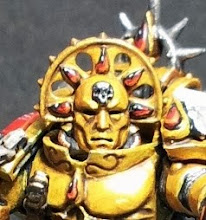
Having assembled the Captain, I couldn't resist going a little further painting him, and he's almost complete now. Thing is, those Space Hulk minis are a bit too nice. It ain't easy to look like a Captain when you're standing next to Sgt Lorenzo...
 "Could I trouble you to, um, stand somewhere else, brother Sergeant?"
And that's all there is for now. Nothing completed yet, what with there being a total of about 40+ marines to cover in Blood Red. That comes to about ~200 coats. The next time I start a new army, I'm definitely getting me a spray gun...
* Heavy weapons yet to be decided, but among those minis there are 6 plasma pistols, 1 plasmagun and 2 plasmacannons. It's a horrible game-turning accident waiting to happen, I know... I love it! Gotta make me one of these one day...
** So they'll be with me for, uh, safekeeping until my nephews are old enough to figure out the rules of 40k and appreciate a good paintjob, which I estimate will be in 2018.
1 Captain
2 full Tactical Squads*
1 full Devastator Squad*
1 full Assault Squad
2 Rhinos
1 Land Raider Crusader
Fans of 40k may notice from the above that if it ain't plastic, I'm not interested. Of the above, the LR Crusader and about 12 bolter-armed marines were hand-me-downs from nephews too young to even assemble a mini**. Hurray for Xmas and misinformed aunts, eh? So, easily a good 1000pts there, with room for tweaking, though I'd like to have a couple of Landspeeders. Up til today, I've been slipping in a little painting time mostly getting through the tedious bit: Coating the little devils with Blood Red. It takes about 5 coats of decently thinned Blood Red to get a nice finish to work with. And up til today, I've been using a hideously tedious method to shade. See previous posts on painting Space Hulk for details. Thing about that method is, owing to my current ineptness, it's a bit hit and miss. Sometimes I can get the wash to behave and slip happily where I want it to with minimal fuss, the rest of the time the surrounding area gets horribly stained and several more coats of very carefully applied Blood Red are needed to correct the error. For example:
 This is after MUCH time and effort spent cleaning up, mind you...
 So, today I tried blacklining for the first time. Joy, joy! I luv marines! Their shape lends itself so well to blackliney goodness! Citadel fine detail brush is now my very good friend...

Unfortunately, in my enthusiasm, the first marine I'd picked to experiment with (centre) didn't quite have enough coats of Blood Red on him yet. Silly me. The other two aren't quite done yet, but there's no denying how wonderfully sharply the shading makes the armour plates stand out. Only downside is I'm worried I won't quite be able to do this too soon after the morning coffee.
Having assembled the Captain, I couldn't resist going a little further painting him, and he's almost complete now. Thing is, those Space Hulk minis are a bit too nice. It ain't easy to look like a Captain when you're standing next to Sgt Lorenzo...
 "Could I trouble you to, um, stand somewhere else, brother Sergeant?"
And that's all there is for now. Nothing completed yet, what with there being a total of about 40+ marines to cover in Blood Red. That comes to about ~200 coats. The next time I start a new army, I'm definitely getting me a spray gun...
* Heavy weapons yet to be decided, but among those minis there are 6 plasma pistols, 1 plasmagun and 2 plasmacannons. It's a horrible game-turning accident waiting to happen, I know... I love it! Gotta make me one of these one day...
** So they'll be with me for, uh, safekeeping until my nephews are old enough to figure out the rules of 40k and appreciate a good paintjob, which I estimate will be in 2018.
Wednesday, February 3, 2010
When I clean my shinai...
... my mind wanders, and I think about any number of things. When I first started kendo and found out you have to dismantle a shinai completely every so often to check it for splinters and cracks, then repair and oil it as necessary, it felt like a chore. After a while it became routine, a part of kendo as much as kirikaeshi or suburi. Of late, it has become meditation.
My hands will move almost automatically, undoing the knots, pulling off the leather parts and spreading open the bamboo. Then running my fingers up and down the length of each bamboo stave, almost caressing it, feeling for the splinters that my eyes can't see. Each irregularity is sanded smooth, each stave given the same care and attention. Then they are rubbed down with oil, just enough to keep a thin film for each stave to absorb, keeping them a little moist to prevent them from getting dry and brittle. The staves are arranged together again, the leather hilt and tip slid on and the cord tightly bound, making the shinai whole again. A few practice swings later and the shinai is laid aside, waiting for the next trip to the dojo.
Lately, while doing this, I find myself thinking of the 'do' in 'kendo', that is, the '道' in '剣道'. Since I've started, kendo has been permeating every aspect of my life. The line dividing the dojo from the world beyond has blurred. One of the things common to every Japanese martial art is the very rigid, very specific etiquette. There is a right and proper way to do pretty much everything. There is a right way to enter the dojo, to leave the dojo, to bow to the dojo, to bow to an opponent, to bow to your teacher... There is a right way to sit, to stand, to walk, to face, to hold your sword when not in use, to don your armour, to put away your armour, to fold your uniform when not in use...
There are dozens, hundreds of little rituals that, over the course of months, become a part of every kendoka, all contributing in some small way to the ideal of the dojo as a place of learning and discipline. I'm not sure how it looks like anymore, from the outside looking in. These days the world seems more real when I'm in keikogi and hakama.
An interesting thought struck me the other day regarding the line between the dojo and the world beyond. In the dojo, when someone points out a flaw or weakness in your technique, you thank him. It does not matter if he is wrong or right, the fact remains that he has taken the effort to observe you and offer an opinion, and so you bow and thank him. And if you're smart, you do not take his critique at face value, but carefully reflect on its validity. This is a prudent, humble and sincere attitude to learning that I consider standard procedure in any dojo worthy of the name. And the thought that hit me was this: Would I behave in this manner outside the dojo?
I want to say 'yes'.
The realities of the world beyond the dojo do not lend themselves well to the ideals of the dojo. Take evolutionary biology. Between biologists, it's perfectly possible and normal for there to be disagreement. The empirical method and peer review are ideally the mechanisms by which scientific progress is made, with experts in their fields pushing forward their pet theories and, with honesty and humility, debating and refining the theories and helping the march of science as a whole. This can be said to be akin to master swordsmen dueling and bettering themselves in the process.
Now, scientists are human, too, and the history of science is replete with examples of backstabbing, oneupmanship, hubris and plain old narrow-mindedness impeding scientific progress. I liken such incidents to the ugly, awkward engagements between novice kendokas that have just begun to don armour and are as yet woefully lacking in technique. In time, hopefully, they will outgrow such silliness. Realistically, in science as in kendo, one will observe a spectrum between the two extremes.
And then there's creationists, who obnoxiously elbow their way into the scene, chock full of ignorance and dogma, proudly braying their "theories" with nary the slightest inkling of the utter absence of any intellectual merit to their position. Now this, this has no parallel in any normal dojo. This is the dojo getting invaded by a party of drunken yobbos, clad in gunny sacks, speaking in grunts and flinging excrement at any who approach. Hmm.
I don't think I'm all that far off the mark in making these comparisons, and this illustrates just one of many aspects of life in which good dojo etiquette alone doesn't quite cut it (ahahaha...). But looking at the creationist example, I can honestly say I'm not sure how to deal with it. Logic and reason do not work against such people, as many rational atheists would no doubt have experienced.
Every time I read the news I can't escape the feeling that the world is becoming a dumber place. On the one hand, on the wings of science and technology we reach higher and higher, yet on the other hand, the evidence suggests that a greater proportion than ever of the world's population is regressing into ignorance and superstition. Amid this maelstrom of conflicting memes, the dojo feels like the last bastion of all that is good about being human. To me, the dojo represents the highest ideals of the human condition; people gathered together with the sincere desire to learn, with the strength and resolve to earn knowledge with sweat, blood and tears.
I try to take the mentality of the dojo with me wherever I go, but, to be sure, it's hard sometimes. Well, not like that'll stop me from trying. Right, this post has gone on long enough. I'm a-gettin' offski.
Oh, in other news, since I started this post, a LOT has happened in my life, some good, others... well, the less said, the better. But on the upside, I done got triple promoted to 2nd kyu :-) And I'm on the Malaysian kendo team taking part in a big scrap in Hong Kong in March. W00t!
My hands will move almost automatically, undoing the knots, pulling off the leather parts and spreading open the bamboo. Then running my fingers up and down the length of each bamboo stave, almost caressing it, feeling for the splinters that my eyes can't see. Each irregularity is sanded smooth, each stave given the same care and attention. Then they are rubbed down with oil, just enough to keep a thin film for each stave to absorb, keeping them a little moist to prevent them from getting dry and brittle. The staves are arranged together again, the leather hilt and tip slid on and the cord tightly bound, making the shinai whole again. A few practice swings later and the shinai is laid aside, waiting for the next trip to the dojo.
Lately, while doing this, I find myself thinking of the 'do' in 'kendo', that is, the '道' in '剣道'. Since I've started, kendo has been permeating every aspect of my life. The line dividing the dojo from the world beyond has blurred. One of the things common to every Japanese martial art is the very rigid, very specific etiquette. There is a right and proper way to do pretty much everything. There is a right way to enter the dojo, to leave the dojo, to bow to the dojo, to bow to an opponent, to bow to your teacher... There is a right way to sit, to stand, to walk, to face, to hold your sword when not in use, to don your armour, to put away your armour, to fold your uniform when not in use...
There are dozens, hundreds of little rituals that, over the course of months, become a part of every kendoka, all contributing in some small way to the ideal of the dojo as a place of learning and discipline. I'm not sure how it looks like anymore, from the outside looking in. These days the world seems more real when I'm in keikogi and hakama.
An interesting thought struck me the other day regarding the line between the dojo and the world beyond. In the dojo, when someone points out a flaw or weakness in your technique, you thank him. It does not matter if he is wrong or right, the fact remains that he has taken the effort to observe you and offer an opinion, and so you bow and thank him. And if you're smart, you do not take his critique at face value, but carefully reflect on its validity. This is a prudent, humble and sincere attitude to learning that I consider standard procedure in any dojo worthy of the name. And the thought that hit me was this: Would I behave in this manner outside the dojo?
I want to say 'yes'.
The realities of the world beyond the dojo do not lend themselves well to the ideals of the dojo. Take evolutionary biology. Between biologists, it's perfectly possible and normal for there to be disagreement. The empirical method and peer review are ideally the mechanisms by which scientific progress is made, with experts in their fields pushing forward their pet theories and, with honesty and humility, debating and refining the theories and helping the march of science as a whole. This can be said to be akin to master swordsmen dueling and bettering themselves in the process.
Now, scientists are human, too, and the history of science is replete with examples of backstabbing, oneupmanship, hubris and plain old narrow-mindedness impeding scientific progress. I liken such incidents to the ugly, awkward engagements between novice kendokas that have just begun to don armour and are as yet woefully lacking in technique. In time, hopefully, they will outgrow such silliness. Realistically, in science as in kendo, one will observe a spectrum between the two extremes.
And then there's creationists, who obnoxiously elbow their way into the scene, chock full of ignorance and dogma, proudly braying their "theories" with nary the slightest inkling of the utter absence of any intellectual merit to their position. Now this, this has no parallel in any normal dojo. This is the dojo getting invaded by a party of drunken yobbos, clad in gunny sacks, speaking in grunts and flinging excrement at any who approach. Hmm.
I don't think I'm all that far off the mark in making these comparisons, and this illustrates just one of many aspects of life in which good dojo etiquette alone doesn't quite cut it (ahahaha...). But looking at the creationist example, I can honestly say I'm not sure how to deal with it. Logic and reason do not work against such people, as many rational atheists would no doubt have experienced.
Every time I read the news I can't escape the feeling that the world is becoming a dumber place. On the one hand, on the wings of science and technology we reach higher and higher, yet on the other hand, the evidence suggests that a greater proportion than ever of the world's population is regressing into ignorance and superstition. Amid this maelstrom of conflicting memes, the dojo feels like the last bastion of all that is good about being human. To me, the dojo represents the highest ideals of the human condition; people gathered together with the sincere desire to learn, with the strength and resolve to earn knowledge with sweat, blood and tears.
I try to take the mentality of the dojo with me wherever I go, but, to be sure, it's hard sometimes. Well, not like that'll stop me from trying. Right, this post has gone on long enough. I'm a-gettin' offski.
Oh, in other news, since I started this post, a LOT has happened in my life, some good, others... well, the less said, the better. But on the upside, I done got triple promoted to 2nd kyu :-) And I'm on the Malaysian kendo team taking part in a big scrap in Hong Kong in March. W00t!
Sunday, January 10, 2010
平成22年が来たぞ!
The 22nd year of Heisei is here!
And after a busy Xmas and New Year full of toddlers, snow, Avatar*, snow, okonomiyaki, one woefully inept circus, one singularly amazing circus, snow, Space Marines** and buggers knows how many thousand suburi with a beyootiful new shinai, here I sit, taking stock of the year that passed and pondering the year ahead.
So, first things first, how did I do with last year's resolutions?
1. Get back to kendo - Hell, yeah! 2 kyu up from the day that resolution was made and totally stoked for the next grading in a fornight! And then it goes downhill from there.
2. Go to Japan - Practically everyone I know has been there. After many months of study, here I sit, confident in the knowledge that I speak Japanese better than almost every non-Japanese person I know. And yet I haven't gone, coz I simply can't bear to leave my cats behind. I've been away for a little over 2 weeks and Haruka's gotten really, really clingy since then. She's sleeping in my lap as I type this.
3. Finish my 1st book - I won't sugar-coat this one. I suck, big time. Too much procrastination, too much self-doubt. Have I learnt nothing from kendo? This is ridiculous, and will be remedied.
4. Get back my Physics kung-fu - This one was a bit half-arsed, but I can honestly say that I'm more intellectually vigilant than before! Not that hard when you're an atheist. I probably should have set more concrete goals...
5. Learn a programming language - Didn't even make a start on this one and, given the current relevance of programming to my present activities, this one has been struck out.
6. Get my weight below 83kg - I'm 86kg now. All I need is a good dose of, say, cholera, and the last 3kg are history. Ahem.
7. Get good enough in Japanese so I don't need subtitles - I'm calling this one half accomplished. I can watch basic no-brain anime like Bleach and Naruto sans subtitles, but Bakemonogatari continues to mystify me. My efforts continue.
Well, apart from the kendo, that was lame. What the hell, something's better than nothing, so here's 2010's resolutions:
1. Finish 1st book!
2. Get back Physics kung fu. At least enough that I can fiddle about with 1st year Quantum Mechanics, Thermodynamics and Calculus with reasonable confidence. Bonus stage: Find out what the hell it was I was missing all those times I slept during Waves lectures...
3. Really, go to Japan. And while I'm at it, pick up a load of cheap little goodies to customize my swords and armour. Hell, maybe pick up a new breastplate.
4. Reclaim ALL my 3-club juggling tricks. Also, construct a nice, big firestaff. About 6 feet should do it.
5. Finish the reading list! Seriously, there's an obscene number of books in here demanding my attention and RM110 in book vouchers to boot...
6. Paint up 1000pts of Blood Angels. Expand to 1500pts. Because old habits die hard. On the upside, I don't need to waste any money on codices, coz the lovely Japanese Games Workshop site has the pdfs (in Japanese, of course) for free. We'll put it down as part of my Japanese studies, eh? ;-) Plus, it's something fun for my nephews to look forward to when they get old enough to learn to WH40k... sometime in 2016. かの者ら、恐怖を知らざる者ゆえに。。。
Alrighty, then. Gotta read, gotta paint, gotta train, gotta write, gotta go, right now...
*Watched it 3 times, twice in 3d. Don't ask.
** Via a series of fortunate events, coupled with my own woeful inability to shake the Games Workshop addiction.
And after a busy Xmas and New Year full of toddlers, snow, Avatar*, snow, okonomiyaki, one woefully inept circus, one singularly amazing circus, snow, Space Marines** and buggers knows how many thousand suburi with a beyootiful new shinai, here I sit, taking stock of the year that passed and pondering the year ahead.
So, first things first, how did I do with last year's resolutions?
1. Get back to kendo - Hell, yeah! 2 kyu up from the day that resolution was made and totally stoked for the next grading in a fornight! And then it goes downhill from there.
2. Go to Japan - Practically everyone I know has been there. After many months of study, here I sit, confident in the knowledge that I speak Japanese better than almost every non-Japanese person I know. And yet I haven't gone, coz I simply can't bear to leave my cats behind. I've been away for a little over 2 weeks and Haruka's gotten really, really clingy since then. She's sleeping in my lap as I type this.
3. Finish my 1st book - I won't sugar-coat this one. I suck, big time. Too much procrastination, too much self-doubt. Have I learnt nothing from kendo? This is ridiculous, and will be remedied.
4. Get back my Physics kung-fu - This one was a bit half-arsed, but I can honestly say that I'm more intellectually vigilant than before! Not that hard when you're an atheist. I probably should have set more concrete goals...
5. Learn a programming language - Didn't even make a start on this one and, given the current relevance of programming to my present activities, this one has been struck out.
6. Get my weight below 83kg - I'm 86kg now. All I need is a good dose of, say, cholera, and the last 3kg are history. Ahem.
7. Get good enough in Japanese so I don't need subtitles - I'm calling this one half accomplished. I can watch basic no-brain anime like Bleach and Naruto sans subtitles, but Bakemonogatari continues to mystify me. My efforts continue.
Well, apart from the kendo, that was lame. What the hell, something's better than nothing, so here's 2010's resolutions:
1. Finish 1st book!
2. Get back Physics kung fu. At least enough that I can fiddle about with 1st year Quantum Mechanics, Thermodynamics and Calculus with reasonable confidence. Bonus stage: Find out what the hell it was I was missing all those times I slept during Waves lectures...
3. Really, go to Japan. And while I'm at it, pick up a load of cheap little goodies to customize my swords and armour. Hell, maybe pick up a new breastplate.
4. Reclaim ALL my 3-club juggling tricks. Also, construct a nice, big firestaff. About 6 feet should do it.
5. Finish the reading list! Seriously, there's an obscene number of books in here demanding my attention and RM110 in book vouchers to boot...
6. Paint up 1000pts of Blood Angels. Expand to 1500pts. Because old habits die hard. On the upside, I don't need to waste any money on codices, coz the lovely Japanese Games Workshop site has the pdfs (in Japanese, of course) for free. We'll put it down as part of my Japanese studies, eh? ;-) Plus, it's something fun for my nephews to look forward to when they get old enough to learn to WH40k... sometime in 2016. かの者ら、恐怖を知らざる者ゆえに。。。
Alrighty, then. Gotta read, gotta paint, gotta train, gotta write, gotta go, right now...
*Watched it 3 times, twice in 3d. Don't ask.
** Via a series of fortunate events, coupled with my own woeful inability to shake the Games Workshop addiction.
Wednesday, December 16, 2009
About those ducks....
That thing I mentioned about Mandarin ducks being romantic? I totally take it back. Damn...
http://www.newscientist.com/article/dn11764-female-ducks-fight-back-against-raping-males.html
http://www.newscientist.com/article/dn11764-female-ducks-fight-back-against-raping-males.html
Monday, December 14, 2009
Life and Kendo
I have been thinking of late of how well kendo lends itself to metaphor. Of course, there are any number of activities out there which make fine metaphors for life. One that springs particularly readily to mind is juggling, seeing as I've been down that road before*. Indeed, if one simply takes the trouble to connect the dots and make the right generalizations to any learning activity, one will find that the universe has many lessons, all around us, for those who will but open their eyes.
But I find myself drawn time and again to kendo. I think it lies in its austerity. In kendo, the efficacy of every technique is tried and tested in combat. Garbed in armour, behind the mask, secure in the knowledge that it's nigh impossible to cause any significant harm to one's opponent, one encounters in every training session a kind of tightly focused ferocity that is rarely seen in other martial arts, save in the most intense and dedicated dojos. It is a profoundly liberating experience. And there is a sense of sincerity in seeing your opponent release himself against you. And it is absolutely exhilarating to fight one's peers with all the strength you can muster.
In the crucible of combat, any useless movements are quickly weeded out, leaving behind a small set of techniques, tactics and strategies. They are deceptively simple, yet take years of dedication and training to master. It's a bit difficult to appreciate how simple with words alone, so here are a few samples of kata or forms from selected martial arts.
From Wudang, the real Wudang, not this lot, 8 Immortal Staff:
Cheng-style (no relation) Baguazhang:
Shinshinkan's Chatanyara no Sai, just too pretty not to include:
And finally, kendo:
Some straddle the interesting line between dance and martial art. Others function as a small library of basic techniques, teaching the way they flow into one another. All have their merits and share the same trait of being a form of moving meditation. Kendo's kata is a relatively slow, stately, tense affair. Ideally, the attacker should execute his cut like he really means it, forcing his partner to be very serious indeed about defending himself. This tension between the two kendokas adds a powerful dimension to the practice of kata, demanding a measure of concentration and alertness from both that is quite hard to appreciate until you're actually performing the kata yourself.
Which brings me back to my point of kendo as a metaphor for life. I have, from the very beginning, taken a very cerebral approach to kendo. Before even picking up my first shinai, I'd read books on the matter. Even now, having trained in armour for well over a year (it ain't much, I know), I still consume a steady stream of kendo books. In Japanese, of course, as the ones in English are prone to drift in the direction of mysticism and romanticise about the age of samurai and basically miss the whole point of kendo altogether. The memory of my first time crossing blades with a sensei in free sparring is still very fresh in my mind. For those of you with the JCKL dojo reading this, it was Toyoda sensei. Yes, I know. I'm grateful to be alive.
That engagement made it very, very clear to me what it meant to be completely, utterly defeated before even raising my sword to strike. Before that moment, I had committed dozens of techniques and tricks to memory, devised strategems to break past any guard, theorized how I could transfer the skills of deceit learnt in capoeira to the art of the sword. It all came to nothing when I stood against the sensei. In the sheer fury of his kiai and the resoluteness of his stance, my spirit broke. All my attacks, far, far too slow. My mind raged against the absurdity of it. This man is at least twice my age! I should be faster! But back then, for the life of me, I could not see his sword, and was hammered at least a dozen times, hard, on my head and hand before the sensei let me limp away. By then I was seeing stars, and my right hand was trembling so badly I could no longer grip my sword.
I took that as a harsh lesson that, just as metaphysics and theology could never compare to science, no amount of theorizing can hold a candle to learning by experience. I have since thrown myself into many more engagements and can say with great certainty that though I'm some way from the dearly coveted shodan, I've lot more steel in me than I did back then. It's very strange to think about it now. When I'm there, panting and sweating in my armour during free training, what pushes me to go a little further each time to take a point is not some high ideal to be a better kendoka or sheer pride making me refuse to acknowledge defeat, but just a very simple, humble, mantra mouthed under my breath when the going gets tough:
I once calculated that from the first time once picks up a shinai, one must do about 15,000** cuts before you have what it takes to wear armour and really start kendo. 15,000, give or take a couple thousand, depending on your motor skills. With every cut, your body learns a tiny bit more. Then when you get in armour, you start learning all over again. Every training session is an exercise in mindfulness. Every cut must be done to the best of one's ability. And in every engagement, regardless of the disparity in rank, there is something to be learnt. Vita sine litteris mors. Life without learning is death.
I believe there's nothing quite as beautifully human as learning. I've held that belief since I was very young and my dad cleverly left cartoon versions of the Confucian classics in my room. But it is kendo that constantly reminds me of the right attitude towards learning. Knowledge is the brightest of jewels to be treasured and sought. This is to be done with both earnest and vigilance, and at the end of the day, evidence, the crossing of swords in combat, decides all. On the path, there will be passions and urges pulling and pushing us in all sorts of directions. They are not to be fought, because they are a part of what you are. They are to be understood and harnessed. If you doubt, if you hesitate you will lose, not because your opponent is better than you, but because you defeated yourself. Is this not shameful? But it happens to the best of us, and so we learn.
In terms of kendo, I am still young, barely a pollywog in a big, big pond. The mystery of my future beyond shodan is well within the realm of fantasy and speculation. But I know that, as long as I throw myself into the next training session with vigour and really, really work myself to earn that beer, the future can be very bright indeed...
* Note to self: Haven't done torches in a long, long time. Must pick up some kerosene in January...
** Revised from a previous estimate of 10,000.
But I find myself drawn time and again to kendo. I think it lies in its austerity. In kendo, the efficacy of every technique is tried and tested in combat. Garbed in armour, behind the mask, secure in the knowledge that it's nigh impossible to cause any significant harm to one's opponent, one encounters in every training session a kind of tightly focused ferocity that is rarely seen in other martial arts, save in the most intense and dedicated dojos. It is a profoundly liberating experience. And there is a sense of sincerity in seeing your opponent release himself against you. And it is absolutely exhilarating to fight one's peers with all the strength you can muster.
In the crucible of combat, any useless movements are quickly weeded out, leaving behind a small set of techniques, tactics and strategies. They are deceptively simple, yet take years of dedication and training to master. It's a bit difficult to appreciate how simple with words alone, so here are a few samples of kata or forms from selected martial arts.
From Wudang, the real Wudang, not this lot, 8 Immortal Staff:
Cheng-style (no relation) Baguazhang:
Shinshinkan's Chatanyara no Sai, just too pretty not to include:
And finally, kendo:
Some straddle the interesting line between dance and martial art. Others function as a small library of basic techniques, teaching the way they flow into one another. All have their merits and share the same trait of being a form of moving meditation. Kendo's kata is a relatively slow, stately, tense affair. Ideally, the attacker should execute his cut like he really means it, forcing his partner to be very serious indeed about defending himself. This tension between the two kendokas adds a powerful dimension to the practice of kata, demanding a measure of concentration and alertness from both that is quite hard to appreciate until you're actually performing the kata yourself.
Which brings me back to my point of kendo as a metaphor for life. I have, from the very beginning, taken a very cerebral approach to kendo. Before even picking up my first shinai, I'd read books on the matter. Even now, having trained in armour for well over a year (it ain't much, I know), I still consume a steady stream of kendo books. In Japanese, of course, as the ones in English are prone to drift in the direction of mysticism and romanticise about the age of samurai and basically miss the whole point of kendo altogether. The memory of my first time crossing blades with a sensei in free sparring is still very fresh in my mind. For those of you with the JCKL dojo reading this, it was Toyoda sensei. Yes, I know. I'm grateful to be alive.
That engagement made it very, very clear to me what it meant to be completely, utterly defeated before even raising my sword to strike. Before that moment, I had committed dozens of techniques and tricks to memory, devised strategems to break past any guard, theorized how I could transfer the skills of deceit learnt in capoeira to the art of the sword. It all came to nothing when I stood against the sensei. In the sheer fury of his kiai and the resoluteness of his stance, my spirit broke. All my attacks, far, far too slow. My mind raged against the absurdity of it. This man is at least twice my age! I should be faster! But back then, for the life of me, I could not see his sword, and was hammered at least a dozen times, hard, on my head and hand before the sensei let me limp away. By then I was seeing stars, and my right hand was trembling so badly I could no longer grip my sword.
I took that as a harsh lesson that, just as metaphysics and theology could never compare to science, no amount of theorizing can hold a candle to learning by experience. I have since thrown myself into many more engagements and can say with great certainty that though I'm some way from the dearly coveted shodan, I've lot more steel in me than I did back then. It's very strange to think about it now. When I'm there, panting and sweating in my armour during free training, what pushes me to go a little further each time to take a point is not some high ideal to be a better kendoka or sheer pride making me refuse to acknowledge defeat, but just a very simple, humble, mantra mouthed under my breath when the going gets tough:
"Earn your beer, you bastard."
I once calculated that from the first time once picks up a shinai, one must do about 15,000** cuts before you have what it takes to wear armour and really start kendo. 15,000, give or take a couple thousand, depending on your motor skills. With every cut, your body learns a tiny bit more. Then when you get in armour, you start learning all over again. Every training session is an exercise in mindfulness. Every cut must be done to the best of one's ability. And in every engagement, regardless of the disparity in rank, there is something to be learnt. Vita sine litteris mors. Life without learning is death.
I believe there's nothing quite as beautifully human as learning. I've held that belief since I was very young and my dad cleverly left cartoon versions of the Confucian classics in my room. But it is kendo that constantly reminds me of the right attitude towards learning. Knowledge is the brightest of jewels to be treasured and sought. This is to be done with both earnest and vigilance, and at the end of the day, evidence, the crossing of swords in combat, decides all. On the path, there will be passions and urges pulling and pushing us in all sorts of directions. They are not to be fought, because they are a part of what you are. They are to be understood and harnessed. If you doubt, if you hesitate you will lose, not because your opponent is better than you, but because you defeated yourself. Is this not shameful? But it happens to the best of us, and so we learn.
In terms of kendo, I am still young, barely a pollywog in a big, big pond. The mystery of my future beyond shodan is well within the realm of fantasy and speculation. But I know that, as long as I throw myself into the next training session with vigour and really, really work myself to earn that beer, the future can be very bright indeed...
* Note to self: Haven't done torches in a long, long time. Must pick up some kerosene in January...
** Revised from a previous estimate of 10,000.
Wish I had a Pokeball...
... so I could stick this guy in it:
... then send him to battle against, I dunno, something with lotsa spikes. Seriously, how utterly pathetic do you have to be to preach the immorality of Pikachu, based on your own code of morality derived from what is essentially the Bronze Age equivalent of Pokemon?
"Thor! I choose you!"
"Jesus! I choose you!"
"Thor! Hammer attack!"
"Oh, shi-..."
 Hammer attack is super effective!
... then send him to battle against, I dunno, something with lotsa spikes. Seriously, how utterly pathetic do you have to be to preach the immorality of Pikachu, based on your own code of morality derived from what is essentially the Bronze Age equivalent of Pokemon?
"Thor! I choose you!"
"Jesus! I choose you!"
"Thor! Hammer attack!"
"Oh, shi-..."
 Hammer attack is super effective!
Sunday, November 29, 2009
Dolphins =/= Romantic
I was at a friend's wedding dinner earlier this weekend when someone at the same table brought up the subject of the invitation cards for another wedding he'd been to earlier this year. Apparently it had a picture of a pair of bottle-nosed dolphins swimming side by side, and he thought it kinda sweet and romantic, up until I was obliged to point out that the dolphin idea of sexual relationships largely involves kidnapping and gang rape. Oh, yes, indeedy, have a look see.
Word to the wise: You want romantic animals? Stick with Mandarin ducks.
Word to the wise: You want romantic animals? Stick with Mandarin ducks.
Subscribe to:
Posts (Atom)